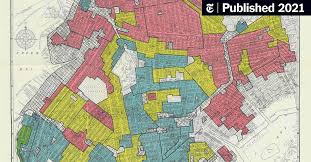
Wealthy suburbs and other areas have high-value homes and thriving businesses, allowing them to raise massive amounts of money for schools even with low tax rates. Urban and rural areas often have lower property values and fewer businesses, meaning even if residents vote to tax, they still generate far less revenue for the schools. Local Governments fund schools by taxing the value of real estate(houses, apartments, and commercial buildings). A simple math equation would be:
For example, a wealthy suburban school district has an average home value of $500,000. If the district sets a 1% property tax rate, that will generate $5,000 per home. Across 1,000 homes, the school district gets $5,000,000.
In another district, the average home value is $100,000. Even if the tax rate is 2%, that is only $2,000 per home. Across 1,000 homes that is $2,000,000. This district produces $3,000,000 less than the suburban district even with double the tax rate.
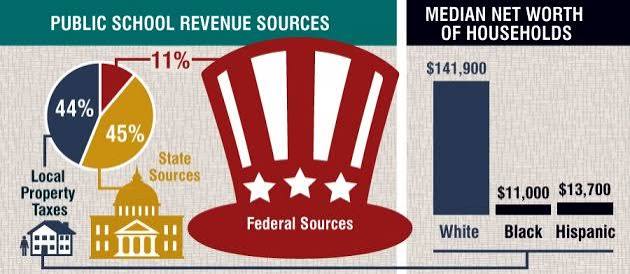
Back in the 1930s, the government hired people to make color-coded maps of many cities to show which neighborhoods were "safe" or "hazardous" to lend money to. Instead of looking at how nice the houses were, the mapmakes looked at race and any Black neighborhhoods were marked as red and named "hazardous." If a Black family wanted to buy a house in their own neighborhoods, banks refused to give them mortgages(a loan to buy a house) beacuse the area was marked in red. If a black family wanted to buy a house in a wealthy white suburban neighborhood, the government and builders banned them form buying houses there.
In white neighborhoods, people could easily get low-interest loans to repair their house or add new rooms. This made the property value go up. In redlined neighborhoods, banks refused to give home-improvement loans, so the owner had to pay to repair or improve their house themselves or leave their houses broken. This made the neighborhood look run-down which made the property values crash. To add to this, in the official maual of appraiser(people who determine a home's worth), if black people moved into a neighborhood, property valuies must automatically go down. To sell a house at a high price, you need many buyers. But in redlined neighborhoods, people couldn't get bank loans so nobody can actually buy the houses. If no one can buy, the sellers have to bring down their prices to find a buyer. This decreases the property value. Homes are worth more when next to nice parks, businesses, and etc. But in redlined areas, businesses refused to open shpps there. oday those old redlined neighborhoods still have much lower property values. Schools in those areas have much letter resources and cash at their disposal.
One popular solution policy is known as the statewide school finance equalization. The first step to this policy is that the state government eliminates local school tax boundaries by collecting all education-focused property taxes in the state into one single fund. instead of giving the funds back to the wealthy districts, the state gives funds based on the actual academic needs of the students. In this plan, every classroom gains a base funding allowance to cover core operational costs like teacher salaries, electricity, textbooks, and utilities. More money will be given to students who need extra support and necessities. This will:
* Give extra funding to schools with many low-income students to pay for multiple academic services, free meals, and high level tutoring
* Provide funding for bilingial educators and translation materials
* Supply students who have special needs with assistive technologies, speech therapists, and specific learing tools.